
 Editorial Team
The era of the personal trainer screaming over a client for one more grueling rep to total physical failure has officially expired. The fitness industry spent decades promoting a culture of chronic exhaustion. Gym-goers were taught that extreme soreness was the only metric of success, and coaches routinely programmed maximum volume without questioning what happened between appointments.
That mindset caused predictable damage: chronic joint inflammation, suppressed nervous systems, plateaued body composition, and high client dropout rates. Today, elite personal training operates under an evolved paradigm. Progressive overload remains the engine of physical adaptation, but that engine accomplishes little if the body cannot rebuild tissue, clear metabolic waste, and restore neuroendocrine balance.
Modern coaching extends beyond designing intense sixty-minute workouts; it engineers the entire systemic adaptation cycle. By modulating training stress alongside autonomic recovery, sleep architecture, and biochemical restoration, trainers help clients achieve sustainable results while protecting long-term health.
The Biological Reality of Adaptation
To balance exercise stimulus with physiological restoration, coaches must address the mechanics of General Adaptation Syndrome. Physical training acts as an artificial stressor. Lifting a loaded barbell creates microscopic micro-tears in skeletal muscle fibers, temporarily depletes intramuscular glycogen, elevates systemic cortisol, and activates the sympathetic branch of the autonomic nervous system.
The workout itself does not build strength; it creates the structural and chemical stimulus that demands adaptation. Tissue growth, cellular remodeling, and mitochondrial biogenesis occur almost exclusively during down-regulated states, primarily through parasympathetic activation during deep sleep and restful wakefulness.
[ Exercise Stimulus ] ──> [ Controlled Micro-Tears & Stress ] ──> [ Parasympathetic Sleep & Rest ] ──> [ Muscle Repair & Growth ]
When a client trains five days a week under high stress while sleeping six hours a night and managing high-pressure workloads, their total allostatic load overflows. Cortisol remains elevated, blunting protein synthesis and impairing glucose disposal. Over time, central nervous system fatigue diminishes motor unit recruitment, causing performance on compound lifts to decay.
A coach’s priority is calculating the minimum effective dose of mechanical tension required to trigger adaptation, then surrounding that stimulus with structured recovery strategies.
Structural Knowledge and Movement Screening
Navigating mechanical loading and recovery requires solid foundational knowledge. Enthusiasts who rely on unverified workout routines often overlook how heavy spinal loading affects autonomic fatigue or how energy systems interact.
Aspiring fitness professionals who complete an accredited level 2 fitness instructor course gain the essential grounding in cardiovascular physiology, functional anatomy, and fundamental biomechanics needed to prevent early client burnout. This qualification establishes how the human body moves, how skeletal muscles generate force, and how basic aerobic pathways replenish adenosine triphosphate during working intervals.
Building on that foundation, coaches can evaluate client movement patterns objectively. Before introducing high-velocity kettlebell complexes or heavy eccentric deadlifts, trainers must verify joint mobility, scapular stability, and postural control. Prescribing high training density to a client who lacks basic movement competence accelerates tissue breakdown and short-circuits systemic recovery.
The Four Pillars of Systemic Recovery
Recovery cannot remain an afterthought relegated to a brief reminder to drink more water. Elite coaches integrate recovery directly into their weekly programming using four core pillars:
1. Autonomic Neuromodulation and HRV Tracking
The central nervous system dictates muscular output. Heart Rate Variability (HRV) the millisecond-level variation between consecutive heartbeats serves as the primary operational window into a client’s autonomic balance.
-
High HRV: Indicates robust parasympathetic tone and physiological readiness.
-
Suppressed HRV: Signals that the sympathetic fight-or-flight branch remains dominant.
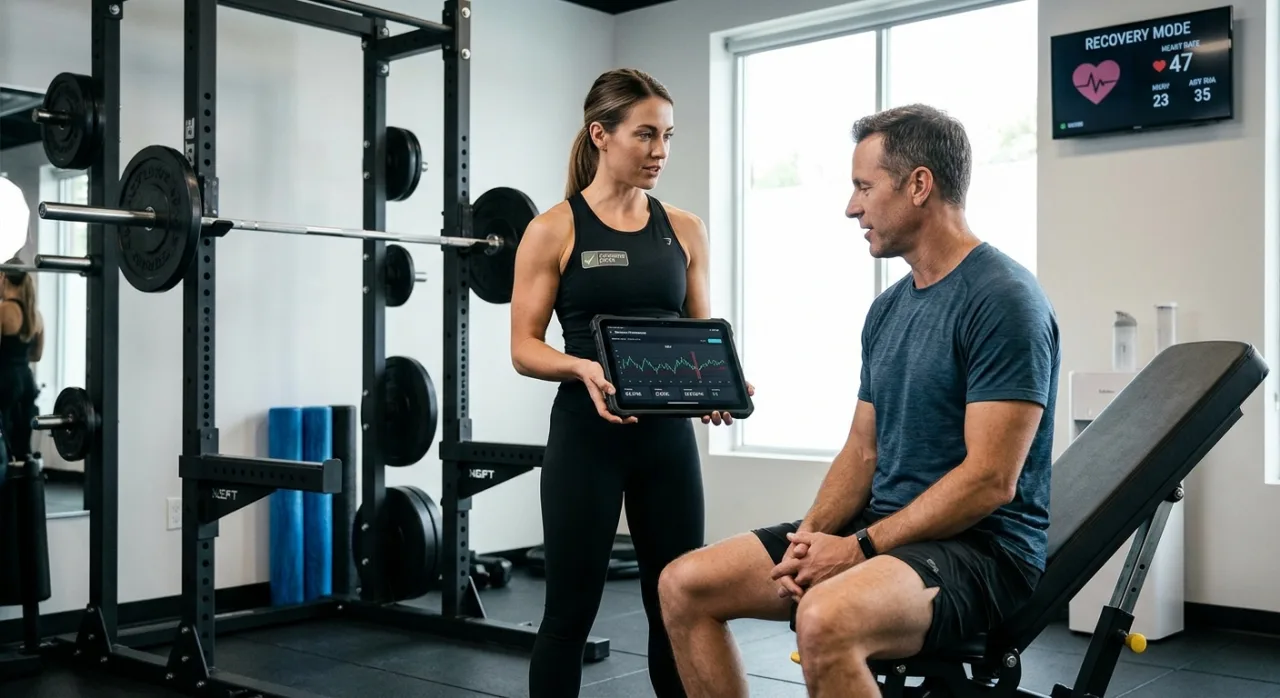
Modern trainers track resting heart rate trends and HRV markers across rolling seven-day averages. When a client’s baseline drops significantly below normal, intelligent coaches swap heavy central loading for active aerobic flushing or mobility drills.
2. Sleep Architecture and Hormonal Pulses
Anabolic adaptation depends directly on slow-wave deep sleep and rapid eye movement (REM) cycles. Growth hormone pulses occur primarily during the first several hours of slow-wave sleep, driving cellular repair and protein synthesis.
If a client trains with relentless intensity but suffers from fragmented sleep or blue-light-induced melatonin suppression, their muscle protein synthesis rate drops significantly. Coaches must actively program sleep hygiene habits: establishing consistent sleep-wake windows, optimizing bedroom temperature, and stopping heavy caffeine consumption eight hours before bedtime.
3. Nutritional Timing and Glycogen Replenishment
Muscle tissue remains sensitized to nutrient uptake following resistance training. While the concept of a rigid thirty-minute post-workout window is outdated, failing to provide adequate amino acids and carbohydrates within two hours impairs glycogen resynthesis and delays myofibrillar repair.
| Nutritional Parameter | Recommended Target | Primary Objective |
| Daily Protein Intake | 1.6 – 2.2 g/kg bodyweight | Supports muscle protein synthesis across 3–4 daily meals with rich leucine profiles. |
| Nutrient Timing | Within 2 hours post-training | Refills muscle/liver glycogen and stops systemic cortisol from cannibalizing lean tissue. |
| Hydration Baseline | 35–45 mL/kg bodyweight daily | Restores cell volume, optimizes nutrient transport, and supports cardiovascular efficiency. |
4. Active Recovery and Deload Waveforms
Passive rest can sometimes prolong delayed onset muscle soreness (DOMS). Light active recovery increases localized blood flow, accelerates lymphatic drainage, and clears metabolic byproducts without taxing the central nervous system.
Incorporating low-intensity steady-state (LISS) aerobic work at Zone 2 cardiovascular output stimulates mitochondrial density while keeping sympathetic stress low. Furthermore, every four to six weeks of progressive overload should conclude with a programmed deload week, reducing working volume by 40% to 50% while maintaining movement intensity.
Addressing Advanced Inquiries and Scope of Practice
As mainstream consumers gain access to continuous glucose monitors, wearable recovery trackers, and specialized health podcasts, clients frequently ask sophisticated questions about biochemical optimization.
One growing area of client inquiry centers on growth hormone secretagogues, cellular repair agents, and tissue recovery compounds. When dedicated lifters encounter plateaued recovery times and search online to buy specialized tissue repair peptides, a knowledgeable trainer needs to explain the underlying endocrine mechanisms rather than simply brushing off the inquiry. Synthetic analogues of growth hormone-releasing hormone function alongside selective secretagogue receptor agonists to prompt the pituitary gland to release endogenous pulses of growth hormone without causing severe spikes in prolactin or cortisol.
However, a personal trainer’s primary ethical duty is maintaining absolute clarity regarding their professional scope of practice. Personal trainers are exercise scientists, biomechanics specialists, and lifestyle educators; they are not endocrinologists, physicians, or licensed medical prescribers.
For clients dealing with systemic fatigue or hormonal imbalances that resist standard sleep hygiene and nutritional adjustments, referring them out to licensed medical clinics specializing in provider-guided peptide therapy ensures their systemic recovery receives qualified physician oversight. Medical practitioners conduct comprehensive diagnostic blood panels, assess renal and liver function, and monitor systemic biomarkers, ensuring any advanced therapeutic intervention operates safely within a supervised medical framework.
Practical Weekly Programming Schedule
To demonstrate how exercise programming and recovery protocols align in practice, here is a structured four-day training week designed for an intermediate client aiming to build lean mass while managing demanding professional responsibilities:
| Day | Focus Area | Training Loading Parameters | Integrated Recovery Protocol |
| Monday | Upper Body Strength | 4 sets of compound horizontal push/pull (5–8 reps @ RPE 8) | Fast-acting carbohydrates + 10 mins down-regulation breathwork |
| Tuesday | Lower Body Hypertrophy | 3–4 sets of squat & posterior chain patterns (8–12 reps @ RPE 7–8) | Contrast water therapy + 30g slow-digesting casein before sleep |
| Wednesday | Active Recovery | 35-minute Zone 2 cardio cycle (120–135 BPM) | Full-body foam rolling + dry sauna + 90-min pre-bed screen blackout |
| Thursday | Upper Body Hypertrophy | 3–4 sets of vertical push/pull & arm isolation (10–15 reps @ RPE 8–9) | Thoracic spine mobility + evening Epsom salt bath |
| Friday | Lower Body Strength | 4 sets of hinge mechanics & single-leg stability (6–8 reps @ RPE 8) | Evening 4,000-step walk + uninterrupted 8-hour sleep window |
| Saturday | Low-Intensity Aerobic | 60–90 minutes steady-state trail walking or recreational cycling | Psychological detachment from metrics + whole-food nutrition |
| Sunday | Systemic Reset | Zero formal resistance loading | Meal preparation + weekly HRV trend review + hydration checks |
This distribution ensures that heavy neural demands are separated by dedicated active recovery windows. Muscles undergo mechanical tension, followed immediately by focused parasympathetic stimulation, allowing the neuroendocrine system to reset before the next training session.
Common Programming Errors to Avoid
Even experienced trainers make subtle calculation errors that compromise client adaptation. Recognizing these failure modes preserves long-term athletic trajectory:
-
Treating Every Set as a Test of Mental Toughness: Training to absolute concentric failure on every set creates excessive central fatigue that outlasts localized muscular recovery. Stopping compound lifts at an RPE of 8 to 9 achieves strong hypertrophic stimulus while keeping one to two reps in reserve to protect central nervous system function.
-
Ignoring Non-Training Stressors: Emotional and professional stress utilizes the same autonomic pathways as heavy front squats. Stress is additive. When client life stress spikes, trainers must dynamically adjust session volume down to match their recovery budget.
-
Neglecting Post-Session Down-Regulation: Heading straight into high-traffic commutes or urgent work emails immediately after a hard session leaves the nervous system trapped in sympathetic overdrive. Ending workouts with 3 to 5 minutes of targeted box breathing stimulates the vagus nerve and initiates recovery faster.
Final Operational Checklist
Before launching or updating a client’s training cycle, audit the programming against these core standards:
-
[ ] Baseline Competence Verified: Does the client demonstrate clean movement quality without pain on all planned exercises?
-
[ ] Volume Matched to Lifestyle: Is total weekly working volume kept between 10 and 20 sets per muscle group based on sleep and stress limits?
-
[ ] Zone 2 Cardio Integrated: Is there at least one dedicated 30–45 minute aerobic flushing session per week?
-
[ ] Deload Scheduled: Is a volume reduction scheduled every 4th to 6th week?
-
[ ] Scope of Practice Upheld: Are recovery suggestions evidence-based, with complex medical or endocrine queries referred to licensed healthcare providers?
Summary
The personal training profession has matured. Clients no longer measure the value of a program by how sore they feel the following morning. They measure value by sustainable energy, progressive performance milestones, injury-free training streaks, and daily vitality. By combining accredited physiological credentials with smart load management and recovery protocols, coaches deliver real, long-term athletic results.